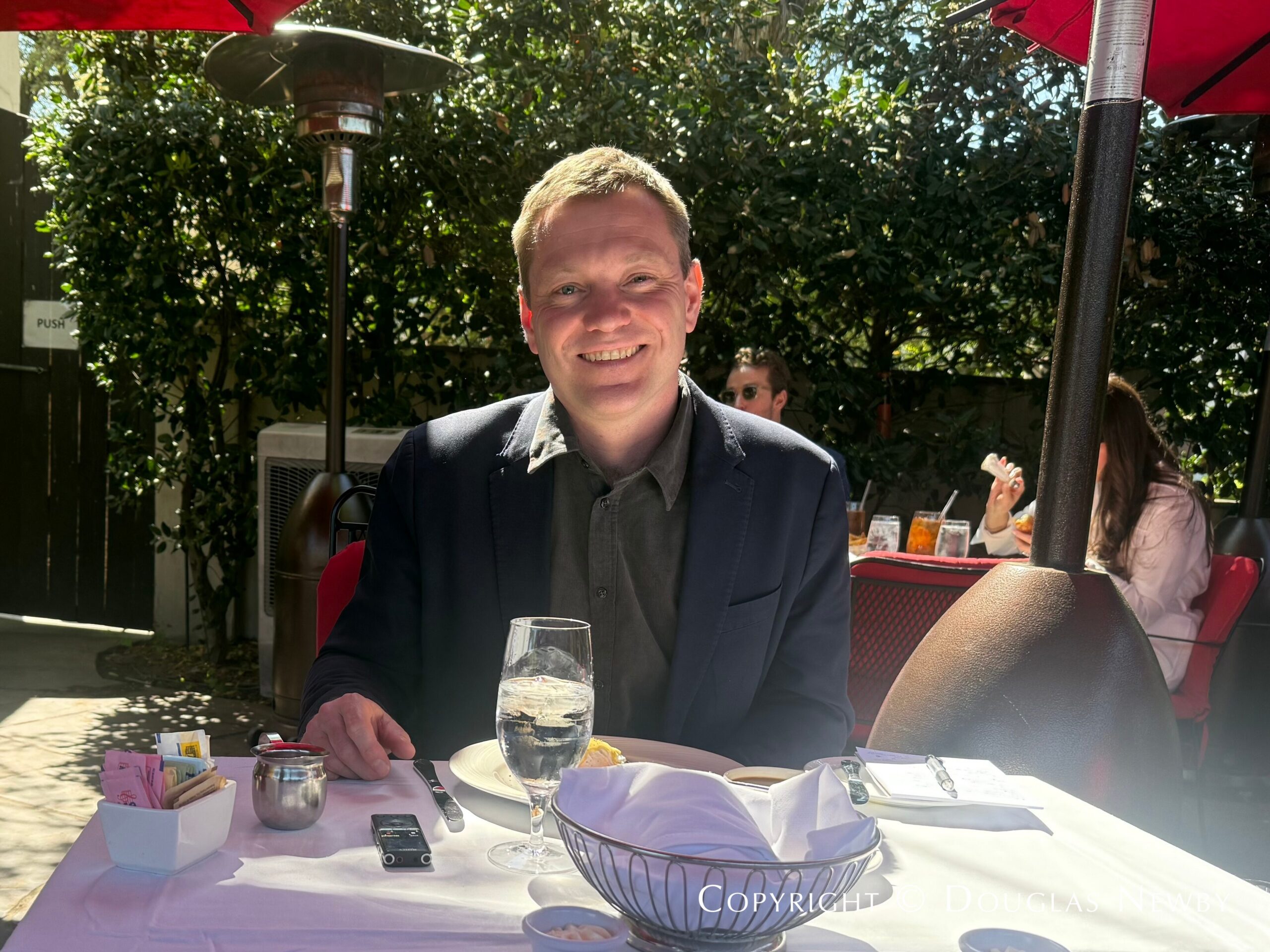
One always learns more about their own city when interviewed by a newspaper correspondent from another country. On this occasion, correspondent Markus Bernsen came over from Denmark to do a full-page back-cover feature story on Dallas for Weekendavisen, the leading newspaper of Scandinavia. He had previously been stationed in Washington, D.C., so he had a good sense of the United States. His understanding of the U.S. provoked his curiosity about why Dallas had become so popular and successful.
Reflecting on our conversation, I realized what never came up was that old cliché or trope—that Dallas has no reason to exist, that it has no ocean, no mountains, but only a can-do spirit—and why this dated trope was not used to describe Dallas.
I think this Dallas trope really began taking hold when, almost out of nowhere, in the 1970 census Dallas was identified as one of the ten largest cities in the country. This sentiment also resonated because oil banking—led by First Republic Bank and First National Bank—and technology and defense—led by Texas Instruments—helped put Dallas on the map, and their founders and leaders were also the political and civic leaders of Dallas, reinforcing that can-do spirit.
Now Dallas is not only a top ten city in population, it has proven its stability and durability, as one of only seven cities to maintain this status for more than 50 years.
People have moved to other top ten cities like Phoenix and San Diego because of the place. People move to Dallas because of the dynamics. In Phoenix, where climate is the draw, the city has roughly twice as many people as jobs. In Dallas, there are more jobs than people.
In the past, the primary geographic attractions for cities were oceans, the Gulf, lakes or major waterways. This drew people to former top ten cities like Boston, Detroit, and St. Louis. Now, being in the center of the country is a greater geographic advantage than waterways.
Dallas benefits from a diversified economy, with six or seven major employment sectors that buffer any one sector that declines or collapses. A good example is the collapse of the Dallas banks in the late 1980s and early 1990s—a time when real estate in Dallas was selling for $0.20 on the dollar. Even in that period of distress, Dallas remained a top ten city.
In contrast, when the car industry declined, Detroit lost more than half its population. When St. Louis was no longer needed as a major transportation hub, it also lost more than half its population.
But beyond a diversified economy, why does Dallas remain resilient and opportunistic? It comes down to the people—and the people I’m talking about are not the can-do predecessors who built Dallas out of nothing. These next generations are different—perhaps personality cousins, but not the same. I’m talking about the people who came to Dallas in 1970 and the people who came to Dallas last month.
Dallas is the most open city in the country. People come to Dallas and immediately sense that it is a city that will embrace them and allow them to contribute—economically, civically, and socially. On every level, Dallas citizens want to contribute, succeed, and move forward. There is a positive momentum in Dallas, and people want to join that momentum. When one’s home, neighborhood, and city improve, one becomes happier and more inclined to contribute to that environment.
People like winners, and Dallas is a winner. As long as taxes stay low, the city is safe, the trees, parks, and trails are nurtured, and schools—from public grade schools to private universities like Southern Methodist University—flourish, families will want to move here, entrepreneurs will start their businesses here, and companies will relocate here.
I think you will enjoy reading the translation of this Danish newspaper article and the conversation Marcus and I had about Dallas.
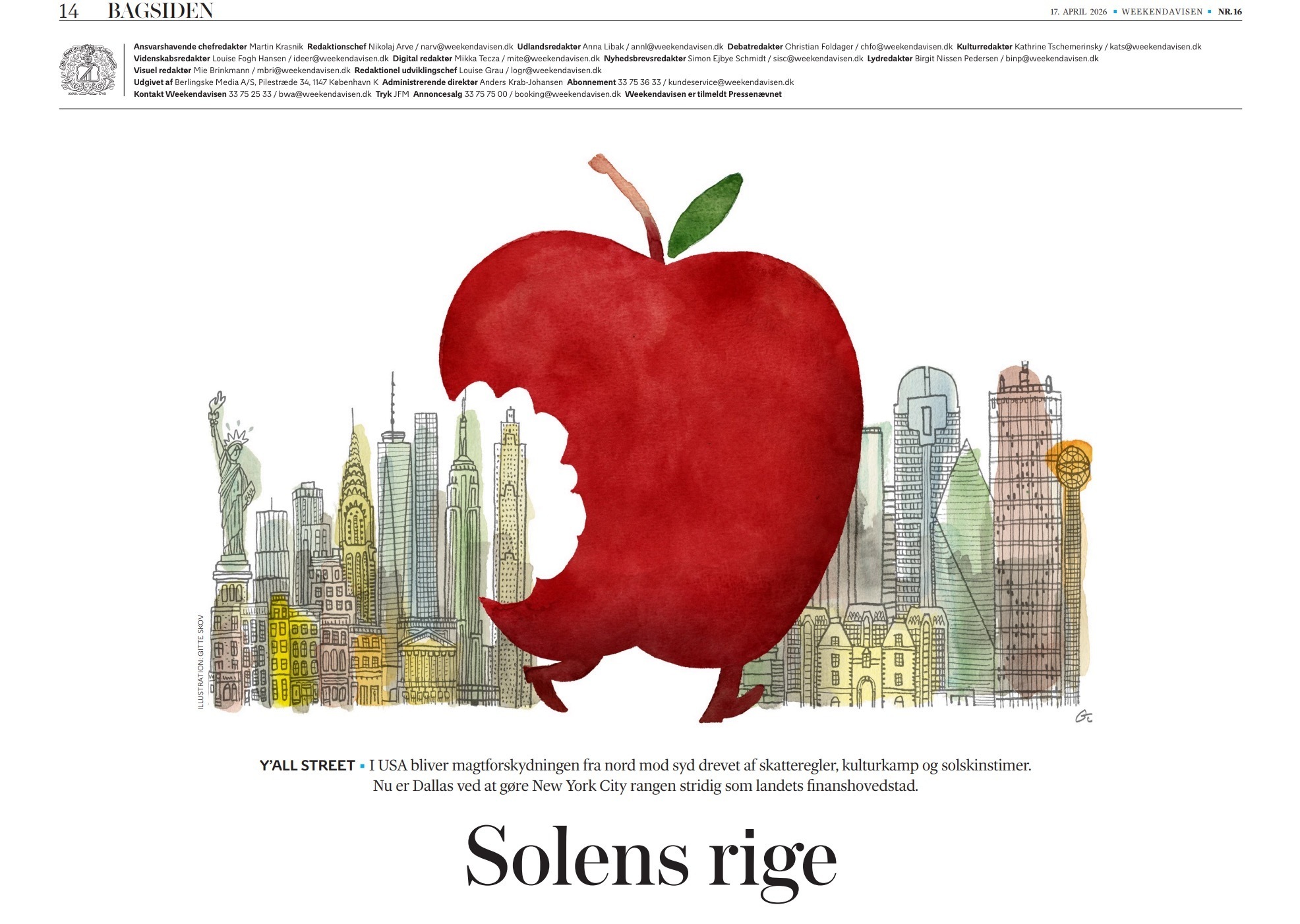
The Realm of the Sun
By Markus Bernsen
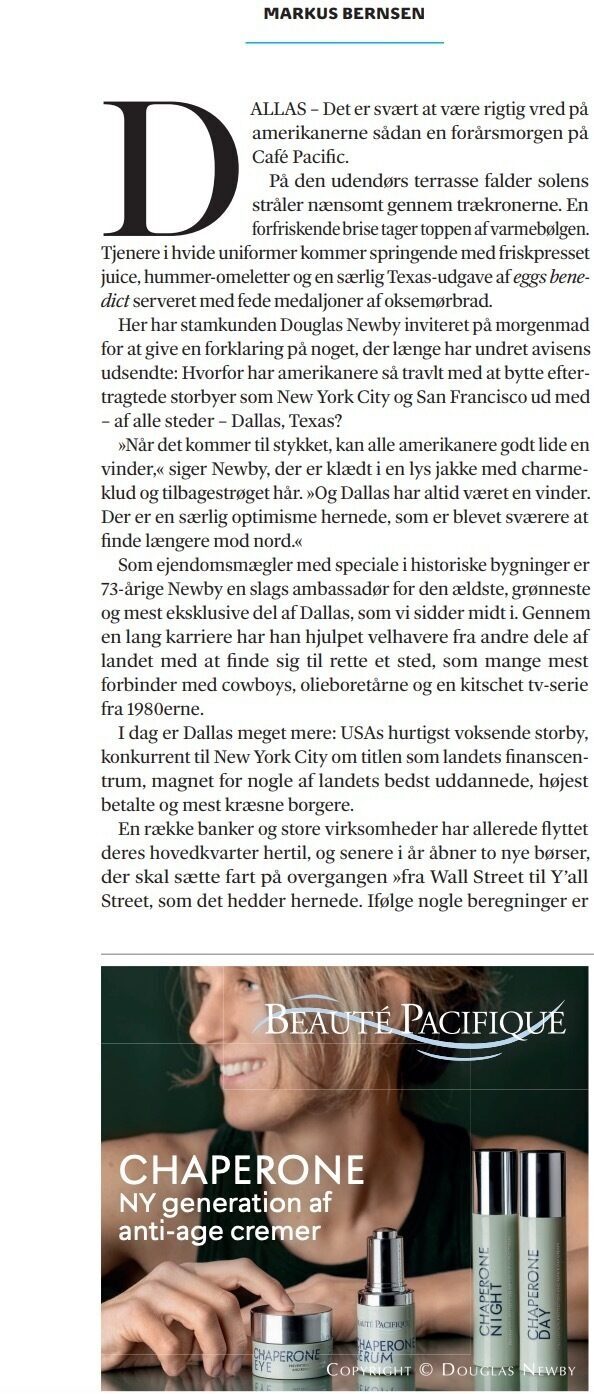
DALLAS — It is hard to stay truly angry on a spring morning like this at Café Pacific.
On the outdoor terrace, sunlight filters gently through the trees. A refreshing breeze softens the edge of the heat. Waiters in white uniforms move quickly between tables with fresh-squeezed juice, lobster omelets, and a Texas version of eggs Benedict topped with thick medallions of beef tenderloin.
Here, regular patron Douglas Newby has invited the newspaper’s correspondent to breakfast to explain something that has long been puzzling: Why are Americans so eager to trade desirable cities like New York and San Francisco for — of all places — Dallas, Texas?
“When it comes down to it, all Americans like a winner,” says Newby, dressed in a light jacket with a pocket square and neatly combed-back hair. “And Dallas has always been a winner. There’s a kind of optimism here that’s become harder to find further north.”
As a real estate broker specializing in historic homes, Newby acts as something of an ambassador for the oldest, greenest, and most exclusive parts of Dallas — where we are sitting now. Over a long career, he has helped wealthy buyers from across the country settle in a place many still associate with cowboys, oil rigs, and a kitschy 1980s television series.
Today, Dallas is much more: the fastest-growing major city in the U.S., a competitor to New York as the nation’s financial center, and a magnet for some of the country’s most educated, highest-paid, and most discerning residents.
A number of banks and major companies have already relocated their headquarters here, and later this year two new stock exchanges will open, accelerating the shift “from Wall Street to Y’all Street,” as it’s known locally. By some estimates, there are already more financial industry employees in the Dallas region than on Wall Street.
Why People Are Moving
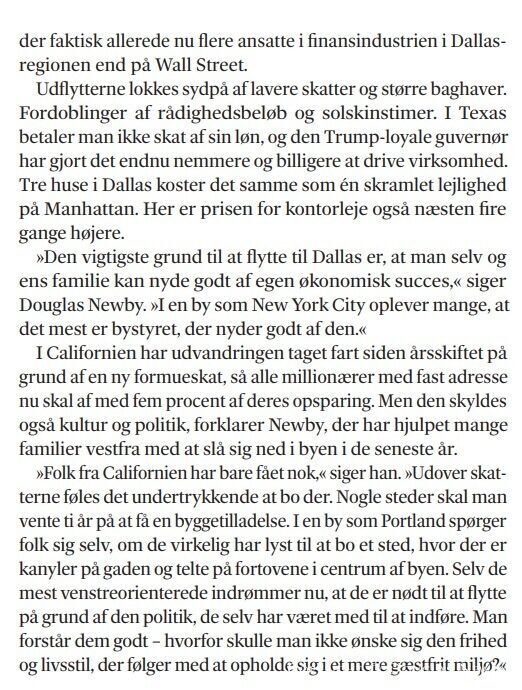
Migrants are drawn south by lower taxes, larger homes, and more sunshine. In Texas, there is no state income tax, and the governor has made it easier and cheaper to run a business.
“Three houses in Dallas cost the same as one worn-down apartment in Manhattan. Office space there can cost nearly four times as much,” the article notes.
“The most important reason to move to Dallas is that you and your family actually get to enjoy your financial success,” says Newby. “In a city like New York, many feel it’s the city government that benefits most.”
In California, the exodus has accelerated since the introduction of a new wealth tax. But culture and politics also play a role, Newby explains.
“People from California have simply had enough,” he says. “Beyond the taxes, it feels restrictive. In some places, it can take ten years to get a building permit. In cities like Portland, people ask themselves whether they really want to live somewhere with needles in the streets and tents on the sidewalks. Even those on the political left now admit they have to leave because of policies they themselves supported.”
Who Wants to Live in New York?

The shift gained momentum during the pandemic, when remote workers discovered the appeal of the South’s climate and tax advantages. It has since accelerated in a polarized political environment.
New York City is considering higher taxes on high earners and businesses, making it even more expensive to operate.
“It’s as if Texas gains 10,000 new residents every time the mayor opens his mouth,” one observer remarks.
Dallas mayor Eric Johnson recently stated: “Dallas is America’s first safe haven from socialism. Business leaders can clearly see that Dallas represents the future of business and the American dream.”
Newby agrees, gesturing around the terrace as plates of French toast and scrambled eggs arrive.
“Build a career in New York? Raise a family in New York? Why would you do that today?” he says. “I love New York — but live there? If you want to play tennis in Central Park, you have to book a month in advance, then spend hours getting there and back. Here, you just walk to beautiful courts by the lake.”
Something Close to Paradise
For generations, the economic center of the U.S. was concentrated in the Northeast corridor from Washington, D.C. to Boston, later expanding to Chicago and the West Coast.
Now the South is rising.
Population growth is strongest in the “Sun Belt,” stretching from Nevada to North Carolina. The ten fastest-growing cities are all located there, including Dallas, Charlotte, and Nashville.
The shift is not just economic. Cities like Charleston and Atlanta have become cultural hubs, while Austin has attracted entrepreneurs like Elon Musk and Joe Rogan.
Major financial institutions are following:
Goldman Sachs is building a massive Dallas campus Bank of America is expanding in the city JPMorgan, Wells Fargo, and Charles Schwab are all increasing their presence
The Wall Street Journal describes this as the most significant geographic shift in global finance since 2008.
Why Dallas Is Winning
“Money and talent are drawn to opportunity,” says Newby.
“Texas has always been a place of opportunity, perhaps because of its history. Many families still carry stories of earlier generations who built homes, worked the land, and created something from nothing. That creates a different mindset than growing up in a rented apartment for generations.”
He adds:
“Texas has always been a place where success is recognized and supported — not demonized.”
Newby remains optimistic:
“When I worry that Dallas might fall behind, I remind myself — you don’t have to outrun the tiger chasing you, only the person next to you. As long as other cities continue behaving irrationally, Dallas will look rational and productive by comparison.”